
Integrative mental health is, by definition, about the whole person: mind, body, and spirit. Traditional approaches like CBT & Motivational Interviewing are valuable tools, but they don’t address every mental health concern, and they certainly do not touch every existential question clients bring into the therapy room (at least not in my practice)!
So let’s talk about it.
It’s also important to clarify what “evidence-based” actually means in clinical practice. Evidence-based practice is not limited to randomized controlled trials. While RCTs are one important form of evidence, the broader clinical definition also includes theoretical papers, qualitative research, case studies, and clinical expertise, alongside client values and lived experience.
In many areas of psychotherapy, especially integrative, transpersonal, and symbolic approaches, theoretical and qualitative work often leads the development of the field. These forms of knowledge are not secondary to RCTs; they are part of how new clinical understandings are built, particularly when studying meaning-making, spirituality, and subjective experience.
This work contributes to ongoing conversations around meaning-making, intuitive development, and the intersection of spiritual frameworks with psychological practice.
As a licensed therapist, I value evidence. I also witness, every day, how powerful holistic and creative approaches can be in supporting insight, emotional processing, and transformation.
Expanding what “evidence-based” means does not mean abandoning rigour. It means recognizing multiple forms of evidence, including theoretical, qualitative, clinical, and experimental research, while continuing to engage critically and responsibly with all of them.
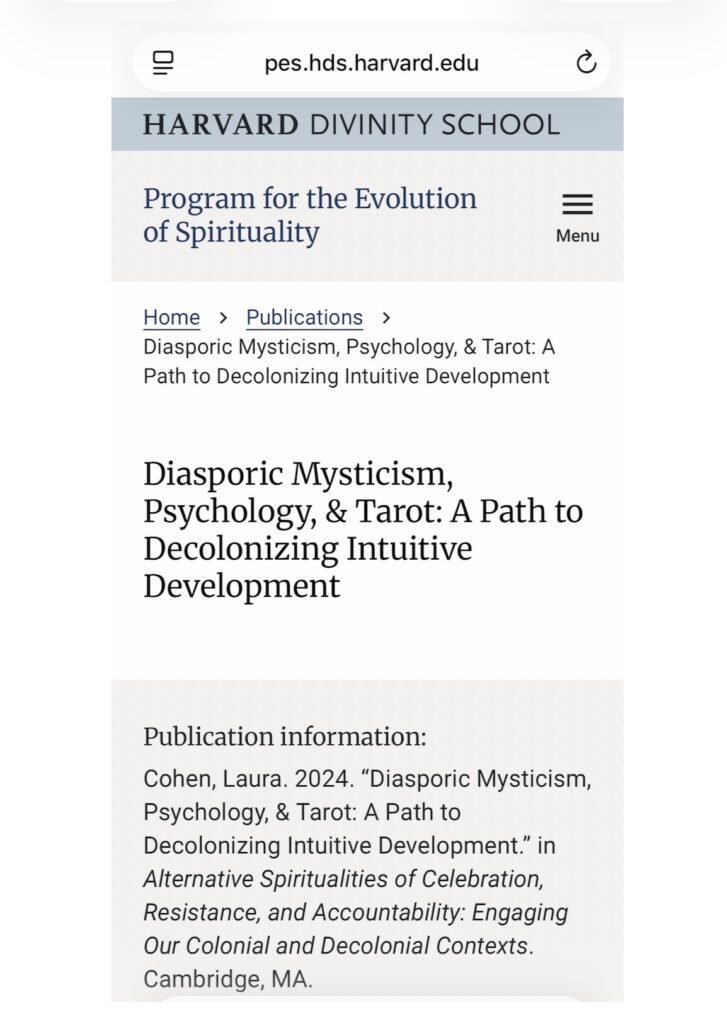
At the end of this post, you will find a curated list of research on Tarot and therapy compiled by Alyse Ruriani, LPC, ATR-BC, bringing together key theoretical, clinical, and applied works in this emerging field. I’m also one of the authors on this list, contributing to the body of research re: Tarot and therapy. I explored these ideas in my paper Diasporic Mysticism: Psychology, Tarot, and the Path of Decolonizing Intuitive Development, published through Harvard Divinity School publications
It is also worth noting that Tarot is only one small part of a much broader landscape. There is a substantial and growing body of work across related areas such as Reiki, mediumship and continuing bonds research (including ADC-informed EMDR approaches), near-death experiences, psychedelic-assisted psychotherapy, transpersonal psychology, and other holistic and integrative methods. This broader field is rich, complex, and increasingly explored across both clinical and academic contexts. Tarot simply represents one entry point into these wider conversations around consciousness, meaning-making, and intuitive healing.
If you’d like to work together I offer 1:1 consulting for witchy therapists and personal/career counselling for witchy people – book a free consult now.
Some Research on Tarot and Therapy:
Bouchard, C. (2020). Therapeutic Practice of Artistically Manifesting a Tarot Pull To Facilitate Personal Insight. Pratt Institute.
Cavallaro, G. B. (2023). Nightscapes of the Tarot: An Artistic Method for Working with Nightmares. Pacifica Graduate Institute.
Clinton, E. (2020). Divining the Self: Applying Tarot as a Projective Technique in Counseling. James Madison University.
Cohen, L. (2024). Diasporic Mysticism, Psychology, & Tarot: A Path to Decolonizing Intuitive Development. https://doi.org/10.31219/osf.io/wgp95
Coulter, A. H. (2004). Pictures That Heal: Messages From the Tarot. Alternative and Complementary Therapies.
DeCarlo, P. (2023). Therapeutic Utilization of Tarot Cards.
DeMarte, V. (2024). Using the Tarot to Heal. University of Maine.
Fink, J. K. (2022). Archetypal Tarot. Jung Journal.
Ferguson, B. (2024). TaRole Theory. Lesley University.
Greenberg, Y. (2023). Tarot as Decolonizing Methodology. Anthropology of Consciousness.
Hofer, G. M. (2009). Tarot Cards: An Investigation of Their Benefit as a Tool for Self Reflection. University of Victoria.
Jones, R. S. (2019). Spirit in Session. Templeton Press.
Marmolejo, C. (2024). Red Tarot. North Atlantic Books.
Moodley, R., & West, W. (2005). Integrating Traditional Healing Practices Into Counseling.
Nichols, S. (2019). Tarot and the Archetypal Journey. Weiser Books.
Pargament, K. I. (2011). Spiritually Integrated Psychotherapy. Guilford Press.
Semetsky, I. (2005–2014). Works on Tarot, semiotics, and psychotherapy integration.
Wen, B. (2015). Holistic Tarot. North Atlantic Books.
Willis-Conger, S. (2022). Tarot and Depth Psychology.
Yar, S. (2019). “Now Therapists Have to Figure Out Astrology, Tarot and Psychedelics.” The New York Times.